If you work on a stepdown, telemetry or intermediate care unit, you already know this kind of nursing has its own pace. Your patients are stable enough to leave the ICU, but they can turn quickly. You watch rhythms, titrate drips, manage BiPAP and catch small changes before they become big ones.
The Progressive Care Certified Nurse (PCCN) credential is a way to show that skill on paper. It tells employers, coworkers and patients that you have proven your knowledge in caring for acutely ill adults.
This guide walks you through what the PCCN is, who qualifies, what it costs, what the exam covers and how to keep the credential once you earn it. If you are on the fence, it will also help you decide whether now is the right time.
What is PCCN certification?
PCCN is a specialty certification for registered nurses who care for acutely ill adult patients. It is granted by the AACN Certification Corporation, the credentialing arm of the American Association of Critical-Care Nurses. AACN first offered the PCCN in 2004.
AACN describes progressive care patients as moderately stable, but at higher risk of becoming unstable. That is the patient who just came out of the ICU after a heart attack, the COPD patient on BiPAP, or the post-op patient on a heparin drip.
Who the PCCN is for
The PCCN is a good fit if you provide direct care to acutely ill adults in units such as:
- Progressive care and stepdown units
- Intermediate care units
- Telemetry units
- Direct observation units
- Transitional care units
- Emergency departments
AACN looks at the patients you care for, not the name of your unit. If your patients match the progressive care profile, your hours can count.
Two ways to qualify
There are two eligibility pathways for the same credential:
- Direct Care pathway: For nurses who care for acutely ill adult patients at the bedside. Most nurses use this pathway, and it is the main focus of this guide.
- Knowledge Professional pathway (PCCN-K): For nurses who shape the care of acutely ill adults without mainly giving direct care. Educators, managers, directors and faculty often fit here.
The PCCN is also accepted by the Magnet Recognition Program. That matters to hospitals that hold or are working toward Magnet status, since they track how many of their nurses are certified.
PCCN vs. CCRN: which one fits you?
Both credentials come from AACN, so nurses often mix them up. The difference comes down to how sick your patients are.
If you work mostly in the ICU, the CCRN is likely the better match. If your patients are a step below ICU level, the PCCN is built for you. Some nurses who float between both settings earn both credentials over time.
PCCN eligibility requirements
To sit for the PCCN exam through the Direct Care pathway, you need two things: a clean license and enough clinical hours.
Licensure
You must hold a current, unencumbered RN or APRN license in the United States. Unencumbered means your license is not under formal discipline and has no conditions that limit your practice, such as required supervision or limits on giving medications.
Clinical practice hours
You must meet one of these two options:
The two-year option works well for full-time nurses. A nurse working three 12-hour shifts a week on a progressive care unit can often reach 1,750 hours in a little over a year. The five-year option is a better fit for part-time or per diem nurses who build hours more slowly.
What counts toward your hours
- Direct care time. Hours spent caring for acutely ill adult patients count.
- Orientation, with a catch. Orientation hours only count if you were the nurse assigned to the patient. Shadowing another nurse does not count.
- Precepting and teaching at the bedside. Managers, educators, preceptors and APRNs can count hours spent supervising nurses or students at the bedside, as long as they are hands-on in patient care.
- Location. Hours must come from a facility in the U.S. or Canada, or one that meets a similar standard.
You will also need to name a clinical supervisor or a colleague (an RN or physician) who can confirm your hours. AACN audits some applications, so keep good records of where and when you worked.
How much does the PCCN exam cost?
The PCCN exam costs $260 for AACN members and $375 for nonmembers. If you are not a member yet, compare the price of a membership against the $115 you would save on the exam. Membership also comes with journals and continuing education credits you can use later for renewal.
Ways to lower the cost
- Ask your employer. Many hospitals pay for certification exams or reimburse you after you pass. Some offer a pay bump for certified nurses.
- Test as a group. AACN offers discounts when 10 or more nurses apply together, and employers can buy exam vouchers at a lower rate.
- Look for scholarships. AACN and its local chapters have offered certification scholarships in the past that cover the exam fee and a review course.
Fees can change, so confirm current pricing on the AACN website before you apply.
What to expect on the PCCN exam
The PCCN is a three-hour, computer-based exam with 150 multiple-choice questions. Only 125 of those questions count toward your score. The other 25 are test questions AACN is trying out for future exams, and you will not know which ones they are, so treat every question as if it counts.
You can take the exam at a PSI testing center or from home through live remote proctoring. If you test on a computer, you see your pass or fail result on screen right away, and a detailed score report arrives by email within 24 hours.
How the exam is scored
AACN does not grade on a curve. A panel of expert nurses sets the passing score by rating how hard each question is. Your score is compared to that fixed standard, not to other test takers.
The PCCN test plan
The exam follows the AACN Synergy Model for Patient Care. About 80% of scored questions test clinical judgment across body systems. The other 20% test professional caring and ethical practice, such as advocacy, patient teaching, teamwork and responding to patients from different backgrounds.
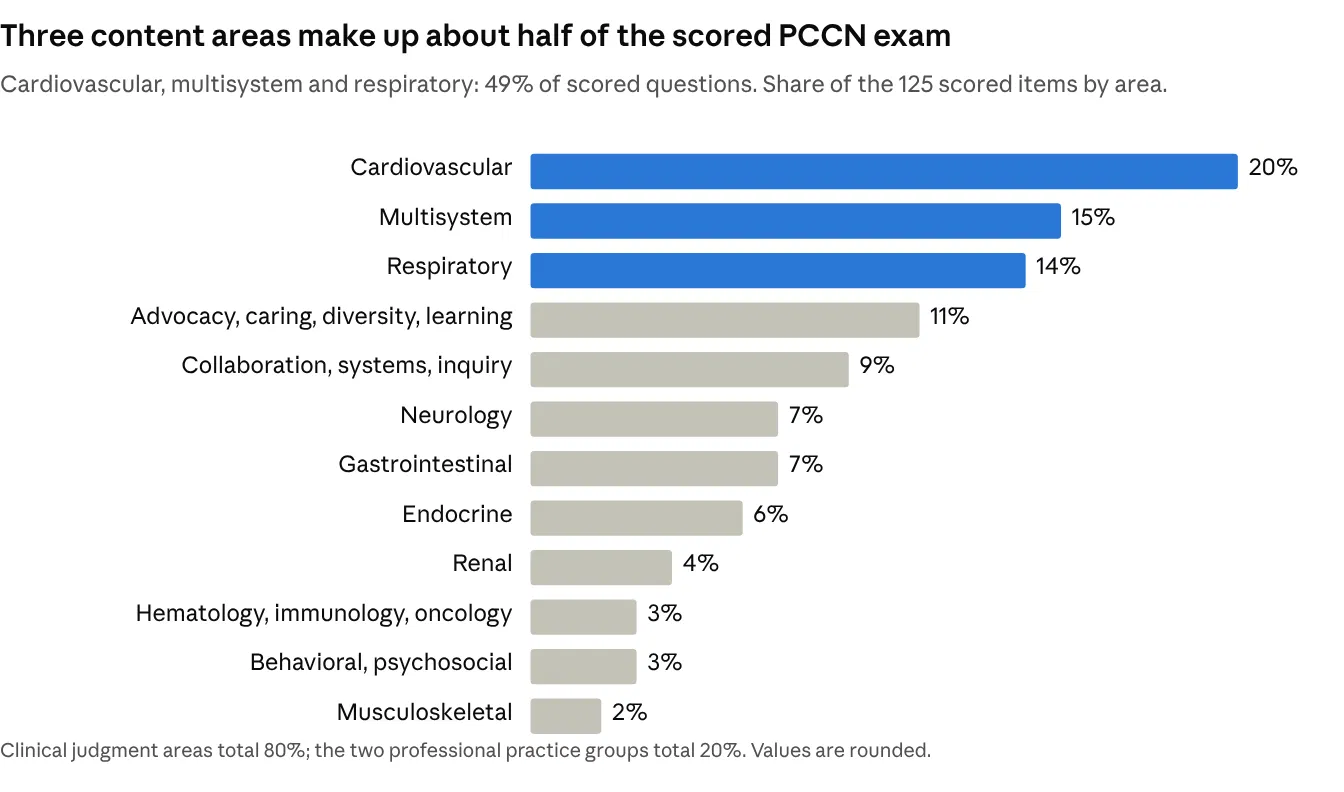
Cardiovascular, multisystem and respiratory topics make up roughly half of the exam. Expect questions on acute coronary syndromes, heart failure, dysrhythmias, sepsis, COPD, pulmonary embolism and respiratory failure.
Skills the exam expects you to know
The test plan also lists hands-on nursing actions you may be tested on. A few examples:
- Reading rhythms, QTc intervals and ST segments
- Managing arterial lines, pacemakers and post-cath patients
- Interpreting blood gases and caring for patients on BiPAP, CPAP or high-flow oxygen
- Titrating insulin drips
- Giving blood products and watching for reactions
- Using the NIH Stroke Scale, delirium screening tools and withdrawal scales like CIWA
- Screening for sepsis
The full list is in the PCCN Exam Handbook. Print it out and use it as a checklist while you study.
How to apply for the PCCN exam
AACN suggests you apply when you are ready to test, not months before. Here is how the process works.
- Gather your details. Have your RN license number and expiration date, a credit card, and the contact information for the supervisor or colleague who will verify your hours.
- Apply online. Go to the AACN certification page and choose PCCN (Adult), Direct Care pathway. Online applications are processed the same day. Paper applications are only needed for group testing, paper-and-pencil exams or testing outside the U.S.
- Watch for your confirmation email. It includes a link to schedule your exam and the window you have to test. That window is normally 90 days.
- Pick your test format and date. Choose a PSI testing center or live remote proctoring at home. If you test from home, you will need a quiet, private room and a computer that meets the technical requirements.
- Take the exam. Bring a government photo ID that matches the legal name on your application.
After you pass, your certification starts on the first day of the month you passed and lasts three years. Your wall certificate usually arrives four to six weeks later.
If you do not pass, you can retest at the lower retest fee. AACN allows up to four attempts in a rolling 12-month period.
How to study for the PCCN exam
Many nurses give themselves two to three months to study while working. You do not need to quit picking up shifts to pass. You need a plan and steady, short study sessions.
Start with the test plan
Use the test plan percentages to decide where your time goes. If cardiovascular content is 20% of the exam and musculoskeletal is 2%, your study hours should look about the same. Take a practice test early to find your weak spots, then focus there first.
Pick a few trusted resources
You do not need ten books. Two or three solid resources are enough:
- The PCCN Exam Handbook. It is free from AACN and includes the full test plan, sample questions and a list of references.
- AACN Essentials of Progressive Care Nursing. This textbook is on the AACN reference list and follows the exam content closely.
- A question bank or practice exam. AACN offers an online practice exam with answer explanations. Other prep companies sell question banks too.
- A review course. AACN and several prep companies offer online review courses. Some also award continuing education credits you can use toward renewal later.
Study tips that work
- Practice questions every day. Even 20 questions a day adds up. Read every answer explanation, including the ones you got right.
- Learn the "why." PCCN questions often ask for the first, best or most important action. Knowing a fact is not enough. You need to know what to do with it.
- Do not skip the professional practice section. It is 20% of the exam. Review advocacy, patient teaching, ethics and teamwork.
- Use your shifts. When you care for a patient with a test plan diagnosis, review that topic after your shift while it is fresh.
- Study with others. A study group or a certified coworker can explain hard topics and keep you on track.
- Take a full practice exam under time limits. Three hours is a long time to focus. Practice the pace before test day.
The week of the exam
Ease up on heavy studying in the last day or two. Review your notes, sleep well and plan your route to the testing center or set up your room for remote testing ahead of time.
How to renew your PCCN certification
Your PCCN lasts three years. To renew through the Direct Care pathway, you need a current, unencumbered license and enough recent practice hours, plus either continuing education or a passing exam score.
Practice hours for renewal
You need 432 hours of direct care with acutely ill adult patients during your three-year certification period. At least 144 of those hours must fall in the 12 months before your renewal date. That is about twelve 12-hour shifts in your final year.
Two ways to renew
If you renew with CERPs, the 100 points must be split across three categories:
- Category A (clinical judgment and clinical inquiry): at least 60 CERPs
- Category B (advocacy, caring practices, diversity and facilitation of learning): at least 10 CERPs
- Category C (collaboration and systems thinking): at least 10 CERPs
- Your choice: the remaining 20 CERPs can come from any category
CERPs can come from CE courses, conferences, precepting, committee work, research and volunteer activities. Keep proof of each one, since AACN may audit your renewal for up to three years.
Timing and grace period
AACN starts sending renewal reminders four months before your renewal date. You have a 90-day grace period after your expiration date to submit your renewal, but your hours and CERPs must be earned before the certification period ends.
If you fall short on hours, you can choose Inactive status. It gives you up to three more years to meet the requirements without losing your credential completely. You cannot use the PCCN title while inactive.
Is PCCN certification worth it?
For most nurses who plan to stay in progressive care for a while, yes. The exam takes real effort and money, but the credential can pay you back in several ways.
- More confidence at the bedside. Studying for the PCCN fills in gaps. Many nurses say they understand the "why" behind their care much better afterward.
- A stronger resume. Certification shows hiring managers you have proven specialty knowledge. That can help when you apply for a new unit, a charge role or a clinical ladder promotion.
- Possible pay increases. Some hospitals offer a certification differential or a one-time bonus. Ask your HR team or manager what your facility offers.
- Value to your employer. Because PCCN counts toward Magnet recognition, certified nurses are an asset to hospitals that track certification rates.
- A step toward CCRN. Many nurses use the PCCN as a building block before moving into critical care.
When to wait
It may make sense to hold off if you are close to the minimum hours, new to progressive care, or planning to leave acute care soon. You also want to be sure you can meet the renewal hours over the next three years. Give yourself time to build experience so the exam content matches what you see on shift.
PCCN certification FAQs
How hard is the PCCN exam?
The PCCN is a challenging exam because it tests clinical judgment, not just memorized facts. Nurses with solid progressive care experience and a focused study plan are well set up to pass.
Can per diem nurses earn the PCCN?
Yes. Per diem hours in direct care of acutely ill adults count the same as staff hours. If you work fewer shifts, the five-year option (2,000 hours over five years, with 144 in the most recent year) may be the easier path.
Do telemetry hours count toward PCCN eligibility?
They can. AACN looks at whether your patients are acutely ill adults, not just the name of your unit. Telemetry is one of the unit types AACN lists for the Direct Care pathway.
Can I take the PCCN exam from home?
Yes. AACN offers live remote proctoring, so you can test from a quiet, private space on your own computer. You can also choose an in-person PSI testing center.
What happens if I fail the PCCN?
You can apply again and pay the lower retest fee. AACN allows up to four attempts in a rolling 12-month period.
How long is PCCN certification valid?
Three years. After that, you renew with practice hours plus either 100 CERPs or a passing exam score.
Taking the next step in your progressive care career
Earning your PCCN is a real commitment. You need the right hours, a few months of focused study and a plan to keep your credential current. In return, you get proof of the skills you already use every shift, plus more options for where your career goes next.
Start by checking your hours against the eligibility rules. Then download the PCCN Exam Handbook, take a practice test and build a study schedule that fits your life.
Flexible work can make all of this easier. Picking up extra shifts on the right units helps you build hours toward eligibility and renewal, while leaving room to study and rest.
CareRev was created by nurses who know how hard it is to balance a career, a schedule and a life. With the CareRev app, healthcare professionals can find and claim per diem shifts at local hospitals. Choose the days you work, pick shifts that fit your schedule and keep growing your experience on your own terms.